Repair or Replace Your Carrier AC in Pomona, CA
Last updated 2026-06-13.
Here is the answer For a Carrier AC in Pomona, CA and ZIP 91767, the repair-or-replace question turns on two tests: keep repairing while a fix stays under half a new system and the unit is under 10 to 12 years, but replace once age times repair cost passes about $5,000, so call (213) 444-4051 or book a visit online. An R-22 system usually tips to replacement, and Pomona Carrier HVAC walks the math with you.
At a glance facts
- Half-price test: repair while the bill stays below half a new system and the unit is under 10 to 12 years.
- Age-by-cost test: once unit age multiplied by repair cost tops about $5,000, replace.
- R-22 systems usually favor replacement; the refrigerant is phased out and costly.
- Compressor $1,200 - $3,500; board $400 - $2,000; refrigerant leak $225 - $1,500.
- Central AC replacement $5,000 - $12,000; heat pump $6,000 - $16,000; furnace $3,000 - $7,500.
- Pomona Zone 9 run hours shorten unit life and speed efficiency payback on new equipment.
- We check Carrier warranty status before quoting a compressor or coil.
What are the two decision rules?
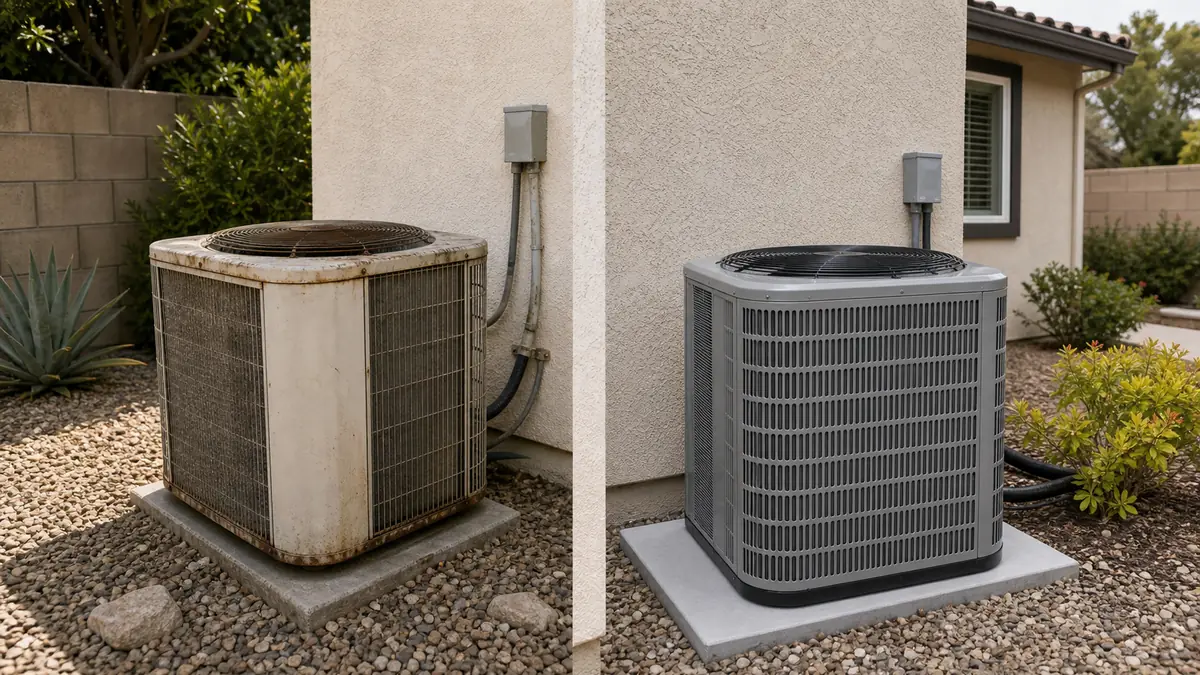
Set feelings aside and let the arithmetic decide. Test one is the half-price test: when a lone repair costs more than about half of a comparable new system and the unit has crossed 10 to 12 years, replacing it usually beats sinking cash into worn-out hardware. Test two is the age-by-cost test: take the unit's age in years times the repair cost, and a product above roughly $5,000 points to replacement. A 15-year-old condenser staring at a $400 repair (15 x 400 = $6,000) is signaling replace. The same $400 fix on a 6-year-old unit (6 x 400 = $2,400) is a clear repair. We run both tests against your actual quote at the house.
| Unit age | Repair likely worth it | Lean toward replacement |
|---|---|---|
| 0 to 8 years | Almost any repair under $1,200 - $3,500 | Only on a total compressor + coil loss |
| 8 to 12 years | Capacitor, contactor, board, blower | Compressor or major coil leak |
| 12+ years | Small electrical fixes only | Compressor, coil, or any R-22 repair |
Does the refrigerant type change the call?
Significantly. Older Pomona systems often run R-22, which has been phased out of production and is now expensive to source. Recharging a leaking R-22 unit is throwing money at a system that will leak again and cannot be cheaply topped up. Newer Carrier equipment uses R-410A, and the industry is transitioning to lower-GWP refrigerants like R-454B. If your R-22 unit needs a coil or compressor, replacement to a modern refrigerant is almost always the better long-term spend - you stop feeding an obsolete system and gain a higher SEER2 unit suited to Pomona's heat.
How does Pomona's climate affect the decision?
It shortens equipment life and speeds the payback on replacement. A condenser in Pomona's Zone 9 heat runs hundreds more hours per year than a coastal unit - 60 to 80 days at or above 90 F, with Santa Ana stretches past 100 F. That run time wears compressors and capacitors faster, so a Pomona unit reaches the replacement threshold sooner than the same unit by the beach. The flip side is that a new, efficient Carrier system recovers its higher SEER2 premium faster here, because it runs enough hours for the efficiency gain to register on your summer bill. The duct condition factors in too: an old system with leaky ducts is a double drain.
When is repair clearly the right call?
When the part is cheap and the unit has life left. A failed run capacitor ($150 - $450) or a pitted contactor ($150 - $450) on a sub-10-year Carrier condenser is a routine, same-visit repair - replacing the whole system over a $300 part would be wasteful. The same goes for a dirty coil, a flame sensor, or a clogged condensate drain. Repair is also the right call when the failed part is still under Carrier's parts warranty; we check that first, because a warranty-covered compressor changes the entire calculation. See the AC repair page for the common repair lanes.
When does replacement win?
When you are facing a major component on an old unit, an R-22 system with a leak, or a string of repairs that keep adding up. A compressor or evaporator coil on a 13-year-old condenser, a recurring refrigerant leak, or a unit that has needed three fixes in two summers are all replacement signals. At that point the smarter move is to put the repair money toward a right-sized Carrier system and seal the ducts while the equipment is open. Compare equipment tiers and rebate caveats in the Carrier buying guide, then see the installation page.
Three worked examples from Pomona service calls
Numbers make the rules concrete, so here are three illustrative scenarios that mirror the calls we run across Pomona's ZIPs. Each one runs both tests - the half-price test and the age-by-cost test - against a real-feeling quote, and shows where the line lands. Treat these as teaching examples, not a quote on your own equipment; we run the same math at your house with your actual readings.
- Wilton Heights bungalow, 7-year-old 26TPA8 Performance 18, blown run capacitor. Repair is a $150 - $450 part-and-labor job. Age-by-cost is 7 x roughly $300, about $2,100, far under the $5,000 line, and the repair is nowhere near half a new system. Clear repair. A capacitor on a near-new two-stage condenser is exactly the kind of fix that buys years for a few hundred dollars.
- Lincoln Park Craftsman, 14-year-old condenser on R-410A, evaporator coil leak. A coil leak repair and recharge runs $225 - $1,500; call it $1,300. Age-by-cost is 14 x $1,300, about $18,200, miles past $5,000, and at 14 years the compressor and contactor are also aging. Replace. The labor to open this sealed system is better spent on a new matched Carrier system you will not be back inside next summer.
- Westmont ranch, 16-year-old R-22 condenser, low on charge. Even a "small" recharge means sourcing scarce, expensive R-22 into a system that will leak again. Age-by-cost on a $600 recharge is 16 x $600, about $9,600, and the R-22 flag alone tips it. Replace, and route the spend toward a 14.3-plus SEER2 Carrier system sized by Manual J.
Does R-22 versus R-410A versus R-454B change replacement timing?
It changes how long you should wait. R-22 was phased out of new production, so any R-22 repair is a stopgap and the unit belongs on the replacement list now. R-410A systems are still fully serviceable, so a leak repair on a younger R-410A condenser can be reasonable. The industry is now transitioning to lower-GWP refrigerants such as R-454B in new equipment, which is one more reason a new Carrier system bought today is a longer-lived investment than feeding an obsolete charge.
| Refrigerant | Status | Repair-or-replace lean |
|---|---|---|
| R-22 | Phased out; scarce and costly | Replace - do not recharge a leaking R-22 system |
| R-410A | Current, fully serviceable | Repair if the unit is young; weigh age and cost |
| R-454B | Lower-GWP, in new equipment | Found in a new install; favors replacing old gear |
Should a Pomona rebate change the timing of a replacement?
Sometimes, but verify before you bank on it. The federal Section 25C credit that once gave heat pumps 30 percent up to $2,000 was repealed effective December 31, 2025, so a 2026 changeout earns no federal credit. Utility money is the live opportunity: LADWP has run heat-pump HVAC rebates widely reported up to roughly $2,500 per ton on an efficiency-tiered scale, SCE has offered around $1,000 per qualifying heat-pump HVAC system, and SoCalGas HEER has covered up to about $600 on a high-efficiency furnace. The statewide TECH Clean California single-family pool was reported fully reserved early in 2026, leaving a waitlist, and all of these run in funding windows that open and close. If your unit is on the bubble between one more repair and replacement, a confirmed live rebate can be the deciding factor - so we check current amounts and your utility eligibility with you rather than promising a number.
Pomona repair-or-replace FAQ
What is the rule for repairing versus replacing an AC in Pomona?
Two quick gut-checks decide it. Gut-check one looks at proportion: a lone repair priced at more than roughly half a brand-new system, on a condenser that has already logged 10 to 12 Pomona summers, tips the scale toward replacing. Gut-check two does the arithmetic: age in years times the repair cost, and a product above about $5,000 - say a 15-year-old unit facing a $400 fix - says replace. At the house we run both against your actual numbers.
My Pomona AC uses R-22 - does that force a replacement?
Often, practically yes. R-22 has been phased out of production, so recharging a leaking R-22 system is expensive and only delays the inevitable. If an R-22 unit needs a coil or compressor, that money is far better applied to a new R-410A or R-454B Carrier system, especially given Pomona run hours.
Is it worth replacing the compressor on an old Carrier condenser?
Rarely, once the unit is past about 12 years. A compressor runs $1,200 - $3,500; on a unit that old you are putting major money into a cabinet, coil, and contactor that are also near end of life. If the compressor is still under Carrier warranty you pay labor only, which can change the math - we check the warranty first.
How much does a full AC replacement cost in Pomona?
A central AC replacement (condenser plus matched coil) runs $5,000 - $12,000, and a ducted heat pump runs $6,000 - $16,000. Adding a furnace is $3,000 - $7,500 and ductwork $1,900 - $6,000. We give a flat installed quote with the permit and HERS verification included, not a vague range.
Will a new system really lower my Pomona summer bill?
Usually, yes - and more here than most places. A modern higher-SEER2 Carrier system runs far more efficiently than a 15-year-old unit, and in Pomona Zone 9 heat it runs enough hours for that efficiency to show up on the bill. Sealing the ducts at the same time compounds the savings.
How many repairs is too many before I should just replace?
Our rough threshold is three real repairs in two cooling seasons, or any second major-component failure. A capacitor one summer and a contactor the next is normal wear on an aging Carrier condenser. But a compressor, a coil leak, and a board fault stacking up on a 12-plus-year unit is the system telling you it is at end of life - at that point each new repair is just renting time on hardware that is failing around it.
If I replace, should I switch from AC to a heat pump in Pomona?
It is worth pricing. Pomona winters are mild, so a Carrier heat pump like the 25VNA4 or a Performance 27TPA8 heats efficiently here with little backup, and one heat pump replaces both the old condenser and the gas furnace. The catch is the federal 25C credit ended December 31, 2025, so the math now rides on utility rebates and your own run hours - we model both an AC-only and a heat-pump path so you can compare installed cost and operating cost side by side.