Carrier Code 31 in Pomona, CA: Pressure Switch / Draft Fault
Here is the answer A Carrier code 31 in Pomona, CA and ZIP 91767 means the pressure switch did not prove draft, so the furnace safely refuses to light - usually a blocked flue, a weak inducer, a cracked sensing tube, or a plugged condensate trap - and Pomona Carrier HVAC measures draft before quoting, so call (213) 444-4051 or book online.
At a glance facts
- Carrier code 31 diagnosis across Pomona ZIPs 91766, 91767, 91768.
- Code 31 = pressure switch or HPSR relay did not close, or reopened mid-cycle.
- Usual causes: blocked flue, weak inducer, cracked sensing tube, plugged condensate trap.
- Pressure switch about $150 to $350; inducer motor about $300 to $700 installed.
- Flue or trap clearing often within the $139 - $200 diagnostic.
- It is a combustion safety stop - we never jumper the switch to force a light.
- Hours Weekdays 7am-6pm, weekends 8am-2pm; we carry common inducer-side parts on the truck.
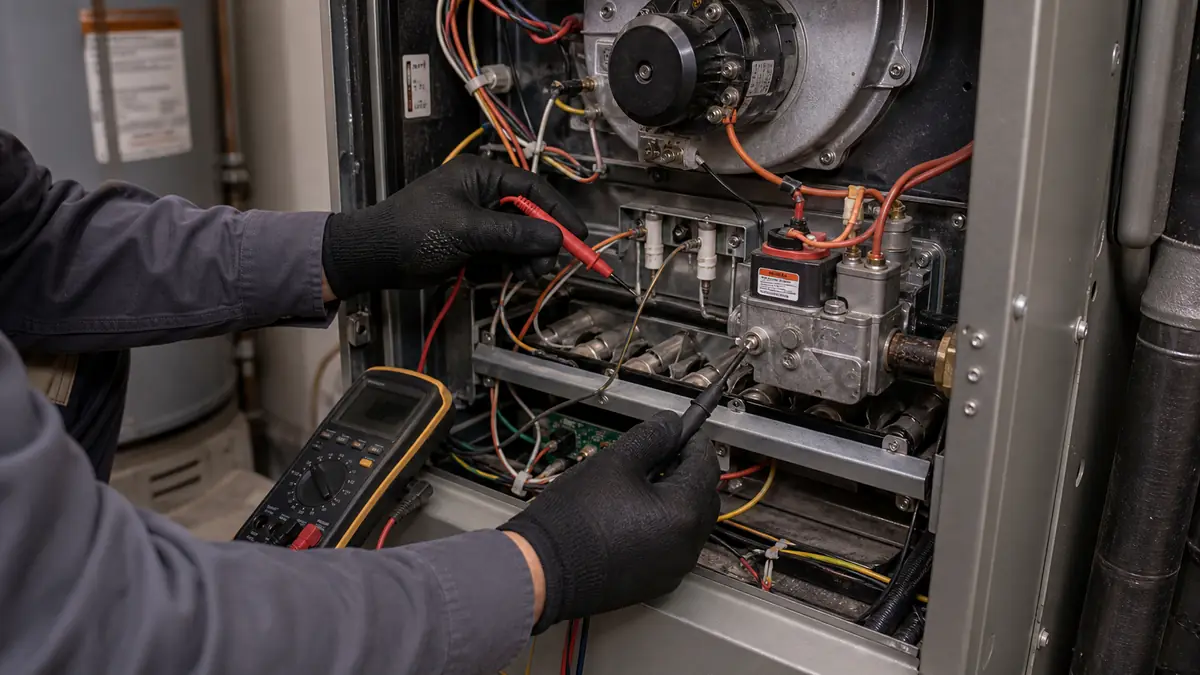
What does code 31 mean on a Carrier furnace?
Code 31 is the furnace reporting that its pressure switch did not do what the control needed. Before the burners ever light, a Carrier 58- or 59-series furnace starts the inducer fan, which pulls a small vacuum that should snap a pressure switch closed. That closed switch is the furnace's proof that exhaust is actually moving up the flue and not backing into your home. If the switch never closes - or closes and then reopens partway through the cycle - the control flashes code 31 (three short, one long on the amber LED) and locks out the ignition sequence. It is not the furnace being fussy. It is the one safety that stands between a clean burn and combustion gases, including carbon monoxide, spilling into a Lincoln Park bungalow or a Phillips Ranch two-story. Treat the code as the furnace doing its job correctly.
Why does my Carrier furnace throw code 31 in Pomona?
The cause is almost always something interrupting draft, and Pomona's housing and climate give a few favorites. In the pre-1960 Craftsman and Spanish-revival homes around Lincoln Park and Wilton Heights, original masonry and metal flues collect rust scale, bird nests, and the occasional Santa Ana-blown debris that chokes the vent. High-efficiency 90-plus furnaces in the newer Hacienda and Ganesha Hills tract homes route through PVC and add a condensate trap - and when that trap dries out over our long, hot, rain-free summer or fills with slime, the switch sees the wrong pressure and trips a 31 on the first cold morning of the season. A tired inducer motor that has lost RPM, a sensing tube that has cracked or slipped off its port from heat cycling, and a partially blocked flue cap round out the list. The dry inland air that defines Climate Zone 9 here means traps and tubing dry, crack, and clog more than they would on the coast.
How do you diagnose a code 31 the right way?
Guessing at a 31 burns money on parts that were fine. We work it with instruments in a fixed order so the real fault is the one that gets fixed:
- Confirm the code and watch a full call - does the switch never close, or close and drop out partway? That split alone narrows the cause.
- Put a digital manometer on the inducer to read actual draft in inches of water column, and compare it to the switch's rated set point stamped on the body.
- Meter the pressure switch for continuity as the inducer runs - a switch that will not close at proven good draft is the failed part.
- Inspect the sensing tube end to end for cracks, soot, condensate, or a port pulled off the inducer housing.
- Check the flue and termination for blockage, and on a 90-plus unit, pour-test and clear the condensate trap and drain.
- Read inducer amperage and RPM behavior - a motor pulling high amps or spinning slow cannot make rated draft.
That sequence tells us whether the fix is a $20 length of tubing, a cleared trap, a pressure switch, or an inducer - and we read draft before we quote a single part.
What can I safely check before calling, and what needs a pro?
A homeowner can safely do a short list. Change a clogged filter, because choked airflow can drag the heat exchanger and inducer out of their happy range. Look at the outdoor flue termination on a high-efficiency unit for a wasp nest, leaves, or a critter screen packed with debris, and clear what you can reach safely from the ground. On a 90-plus furnace, check whether the clear condensate tubing has standing water or is dry and cracked. That is the safe boundary. What needs a pro: reading draft with a manometer, testing the switch under load, and anything involving the inducer wiring. The one thing never to do is jumper or tape the pressure switch closed to make the furnace light - people find that trick online, and it disables the exact safety that stops exhaust from entering your home. If the code persists after a clean filter and a clear vent, leave it off and book a visit. While you wait, confirm your carbon-monoxide alarms work.
What does a code 31 repair cost in Pomona, and when is it urgent?
Most 31 repairs are modest because the common fixes are clearing or a stocked part. The diagnostic is $139 - $200 and includes the manometer draft reading and the switch test. Clearing a plugged sensing tube, flue, or condensate trap frequently finishes inside that visit. A replacement pressure switch lands around $150 to $350, and a failed inducer motor around $300 to $700 installed - both parts we commonly carry. A cracked or rusted-through flue that is the actual blockage source is the higher-cost outlier because it is venting work, not a bolt-on part. On urgency: a 31 is a safe shutdown by design, so it is not a fire-now emergency the way a rollout is - but it does mean no heat, and on the first cold Pomona morning that matters for older residents. Get it diagnosed before the cold snap rather than resetting into a dead furnace. For broader heating faults see the no-heat fix, for the full code map see the Carrier error-codes hub, and for furnace replacement options see the Carrier furnace page.
Pomona Carrier code 31 FAQ
What does code 31 mean on a Carrier furnace?
Code 31 means the pressure switch (or HPSR relay) did not close when the inducer started, or it reopened mid-cycle. In plain terms, the furnace cannot prove it is drafting combustion gases safely up the flue, so the control refuses to light the burners. It is a safety stop, not a nuisance code - the furnace is protecting you from spilling exhaust.
Can I fix a Carrier code 31 myself in Pomona?
You can check the easy stuff: a clogged filter, an obviously blocked flue cap, or standing water in the condensate drain on a high-efficiency unit. Beyond that, code 31 needs a manometer to read inducer draft and a meter to test the switch, so it is a pro repair. Do not jumper the pressure switch to force the furnace on - that defeats a combustion safety.
How much does a Carrier code 31 repair cost in Pomona?
The diagnostic is $139 - $200. Clearing a plugged flue, sensing tube, or condensate trap often finishes within that visit. A replacement pressure switch runs about $150 to $350, and a failed inducer motor about $300 to $700 installed. We measure draft before quoting so you only pay for the part that actually failed.
Is it safe to keep running a Carrier furnace showing code 31?
No. Code 31 means draft is not proven, so combustion byproducts including carbon monoxide could spill into the home if the furnace ran. The control is correctly refusing to light. Leave it off, make sure your CO alarms have good batteries, and have it diagnosed before the next cold snap rather than resetting it repeatedly.